

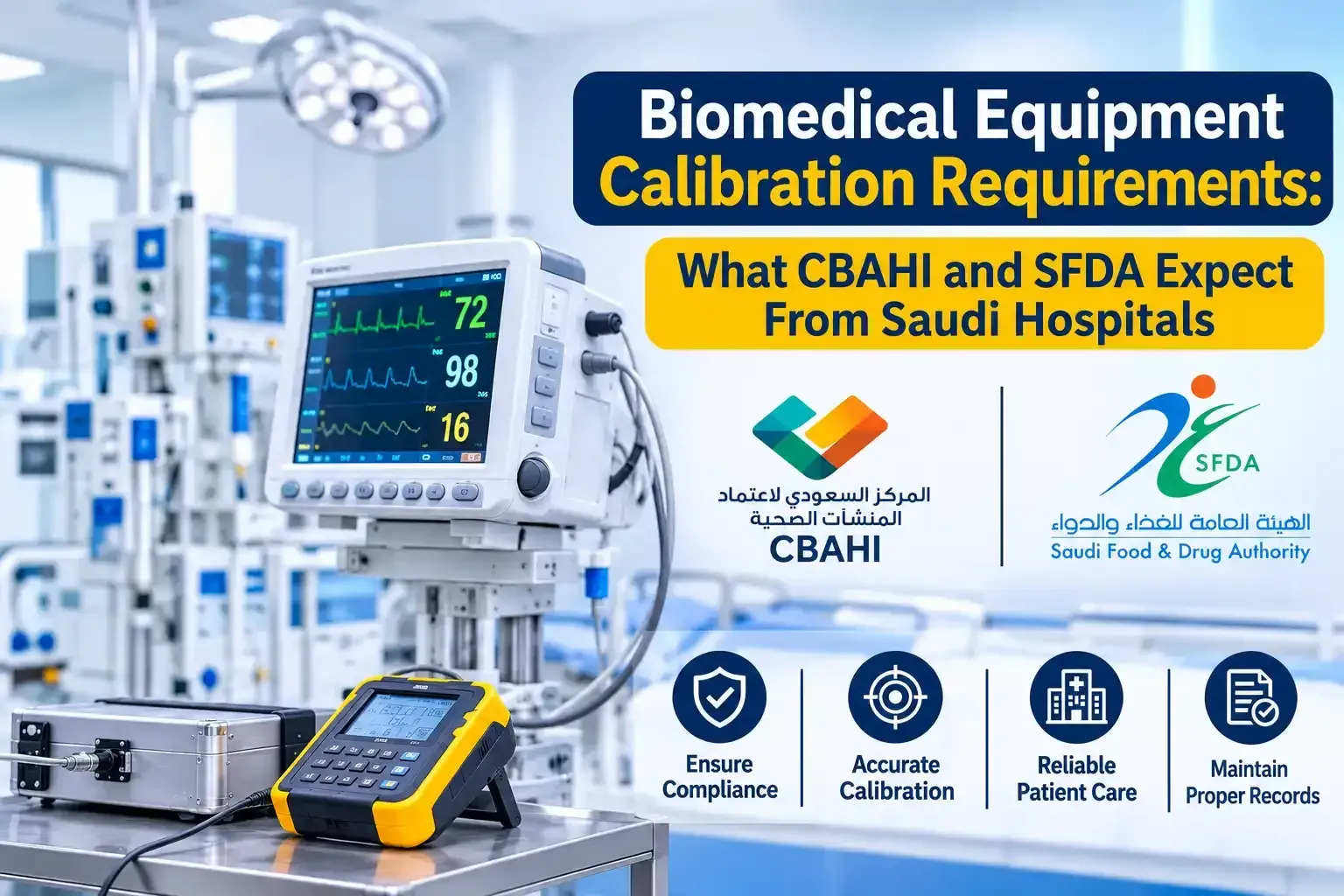
Biomedical equipment calibration requirements decide whether a Saudi hospital sails through a survey or scrambles to find missing records. A ventilator, infusion pump or patient monitor can look fine and still read wrong. For biomedical engineers and quality managers, medical equipment calibration Saudi Arabia regulators and accreditors expect is not optional paperwork. It is proof that devices measure accurately at the bedside.
At General Tech Saudi, our Dammam team has supported industrial and regulated clients since 1998. This guide explains the biomedical equipment calibration requirements CBAHI and SFDA expect, how often to calibrate and how to keep your records audit-ready.
Why Biomedical Equipment Calibration Requirements Matter
Calibration compares a device against a traceable reference and corrects or documents any error. In a hospital, that error reaches patients. An infusion pump that over-delivers, a defibrillator that mis-measures energy or an incubator that drifts in temperature creates direct clinical risk.
Eastern Province conditions add pressure. Heat, dust and heavy daily use accelerate drift. That is why biomedical equipment calibration requirements should sit inside your core patient-safety programme, not on a back-office list.
SFDA Medical Device Calibration: What the Regulator Expects
SFDA medical device calibration expectations for hospitals are set mainly in its requirements for the safe use of medical devices inside healthcare facilities, known as MDS-REQ 3. In summary, healthcare providers are expected to:
- Maintain and calibrate devices according to the manufacturer’s instructions.
- Run a computer-based maintenance management system and a device inventory.
- Document maintenance and calibration for each device in a traceable log.
- Use maintenance providers that meet SFDA licensing rules when work is outsourced.
SFDA has published a newer version of this document, dated July 2026. Earlier versions required maintenance details to be kept for at least five years. Confirm retention periods and any new clauses in the current text on the SFDA website.
What SFDA Medical Device Calibration Records Should Show
A good record lets an inspector trace a device from purchase to today. It should include the asset ID, serial number, location, calibration dates, results, the person or company responsible and the next due date.
CBAHI Calibration Requirements: What Surveyors Look For
CBAHI calibration requirements form part of its hospital accreditation expectations for managing medical equipment. Surveyors generally want evidence of a working programme, not just a certificate in a drawer. This page cannot replace the current CBAHI manual, so check the latest standards for the exact biomedical equipment calibration requirements.
What Surveyors Typically Ask to See
- A complete inventory of medical equipment with risk classification.
- A written schedule for preventive maintenance and calibration.
- Calibration records showing results and due dates.
- Proof that out-of-tolerance devices were removed, repaired and rechecked.
- Evidence that staff and contractors are competent.
Meeting biomedical equipment calibration requirements for SFDA and CBAHI together is simpler than it sounds. One well-run programme can serve both, because both reward documented, risk-based control.
Medical Device Calibration Frequency: How Often Should Medical Equipment Be Calibrated?
If you are asking how often should medical equipment be calibrated, start with the manufacturer’s instructions. Under most biomedical equipment calibration requirements, the manufacturer’s interval is the baseline. Then apply risk to decide whether a shorter interval is wiser.
Medical device calibration frequency is often planned like this:
- Life-support and critical devices (ventilators, defibrillators, anaesthesia machines): every 6 to 12 months, or as the manufacturer states.
- Monitoring and infusion devices (patient monitors, infusion pumps, pulse oximeters): typically every 12 months.
- Temperature-critical equipment (incubators, blood and vaccine refrigerators): every 6 to 12 months.
- Lower-risk devices: per manufacturer guidance and your risk assessment.
Calibrate sooner after repair, relocation, impact damage, a failed safety test or any suspicious reading. Treat these intervals as planning starting points, not legal limits.
Calibration Certificate for Medical Equipment: What to Check
A calibration certificate for medical equipment is only valuable if an auditor can trust it. Check that each certificate shows:
- Device description, model and serial number.
- As-found and as-left readings.
- Reference standards used and their traceability.
- Measurement uncertainty and pass or fail criteria.
- Calibration date, next due date and the technician’s name.
Reject certificates that give only a pass stamp, because biomedical equipment calibration requirements call for traceable evidence. As-found data matters because it shows whether the device was already out of tolerance, which may require a clinical review.
Laboratory accreditation adds confidence. Our SAAC ISO/IEC 17025:2017 accredited calibration services include bio-medical calibration, with as-found and as-left readings on every certificate.
Hospital Equipment Preventive Maintenance and Calibration Together
Hospital equipment preventive maintenance and calibration are different tasks, but they work best on one schedule. Preventive maintenance covers cleaning, safety testing and part replacement. Calibration confirms measurement accuracy.
A joint timeline helps you meet biomedical equipment calibration requirements efficiently:
- Monthly: user checks, alarm tests and cleaning.
- Quarterly: electrical safety checks and consumables.
- Every 6 to 12 months: calibration and performance verification.
- After any event: repair, move or fault triggers retesting.
Combining visits reduces downtime. It also gives one record per device instead of scattered files.
Biomedical Equipment Calibration Requirements Checklist
Use this checklist to test your readiness:
- Build a complete inventory and classify each device by risk.
- Record the manufacturer’s calibration interval for every model.
- Set a written schedule for preventive maintenance and calibration.
- Use accredited laboratories or licensed providers with traceable standards.
- Store certificates against each asset in your maintenance system.
- Investigate every out-of-tolerance result and log the action taken.
- Review overdue items monthly with the quality team.
- Prepare an audit folder before the survey, not during it.
Biomedical Equipment Calibration Service in Dammam: Choosing a Provider
When choosing a biomedical equipment calibration service, ask about accreditation, traceability, turnaround, reporting and how well they understand your biomedical equipment calibration requirements. For biomedical equipment calibration Dammam hospitals need, on-site capability also matters because it reduces device downtime and transport risk.
General Tech Saudi calibrates in its Dammam lab or on site across the Eastern Province, Riyadh, Jeddah and Yanbu. Its calibration disciplines include bio-medical, and its team also offers annual maintenance contracts that track due dates for you. Review the full range on our calibration and maintenance services page.
Hospitals should also confirm any contractor’s SFDA licensing status for medical device maintenance work, and the exact scope of devices covered, before signing. For more technical guidance, browse our latest updates and articles.
Medical Equipment Calibration Compliance: Common Gaps
Medical equipment calibration compliance usually fails in the same places:
- Devices missing from the inventory
- Calibration done but certificates not filed
- No as-found data on certificates
- Overdue labels ignored on the ward
- No follow-up after out-of-tolerance results
Fixing these gaps strengthens every part of your biomedical equipment calibration requirements programme.
Frequently Asked Questions About Biomedical Equipment Calibration Requirements
Does SFDA require medical equipment calibration in hospitals?
SFDA’s requirements for safe use of medical devices expect hospitals to maintain and calibrate devices per manufacturer instructions and to keep records. Check the current version of MDS-REQ 3 for exact clauses.
How often should medical equipment be calibrated?
Follow the manufacturer’s interval first. Many hospitals calibrate critical devices every 6 to 12 months and most monitoring devices annually, adjusted by risk and condition.
What should a calibration certificate for medical equipment include?
It should show device identity, as-found and as-left results, traceable reference standards, uncertainty, dates and the technician. Without these, auditors may question its value.
Can one calibration programme satisfy both CBAHI and SFDA?
Largely yes. Both expect inventory, risk-based schedules and documented results, so a single well-documented programme can serve both. Always check each body’s current text.
Stay Audit-Ready Before the Next Survey
Clear biomedical equipment calibration requirements, a risk-based schedule and complete certificates protect patients and your accreditation. If your records have gaps, start with an inventory review and book calibration for overdue devices.
General Tech Saudi (BK General Tech Services Est.)
P.O. Box 9559, Al Rabie District, Dammam 31423, Saudi Arabia
Phone: +966 569 289 544 | Email: sales@generaltechsaudi.com