

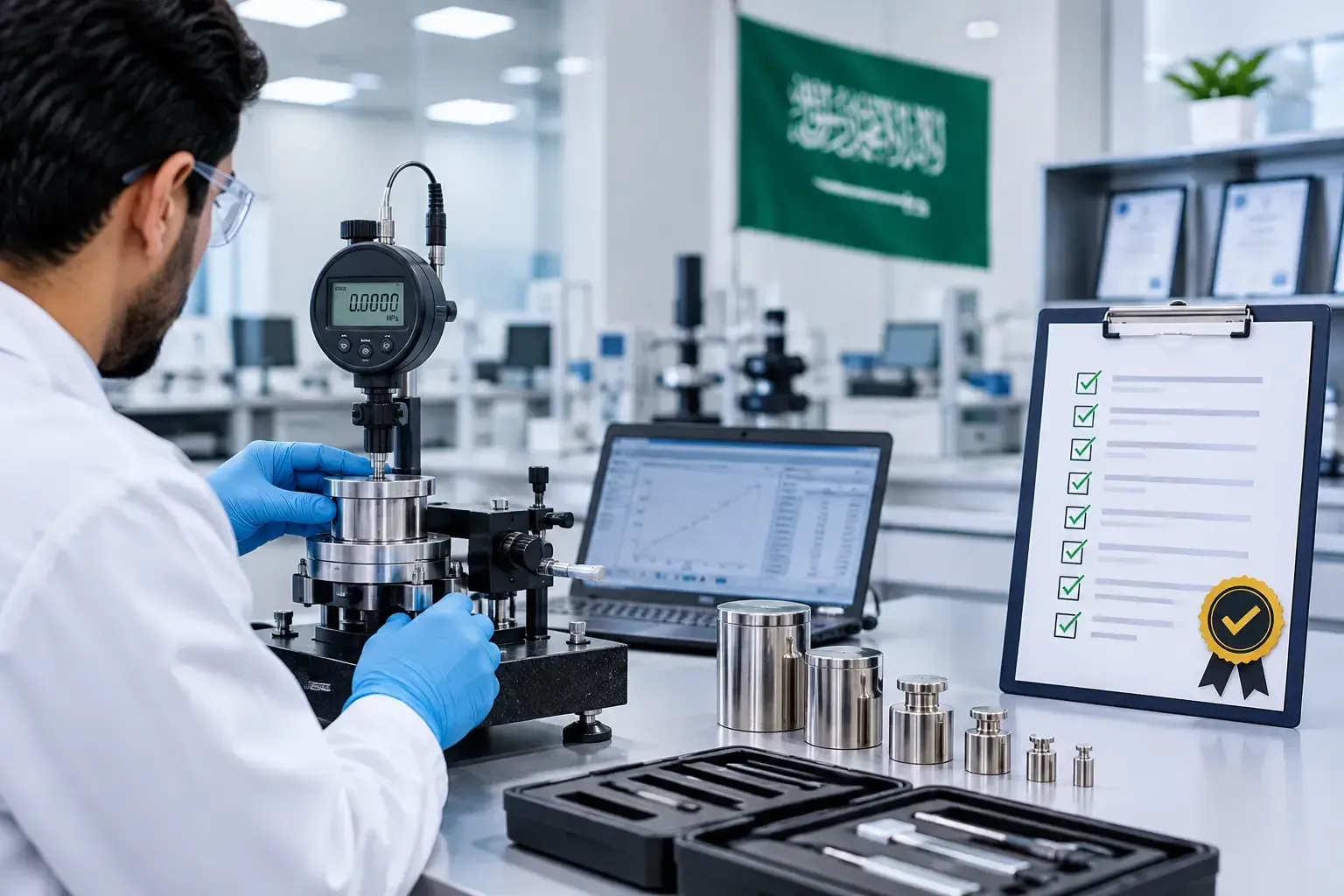
How to choose a calibration lab is a question every procurement manager and quality engineer in Saudi Arabia faces before an audit, a shutdown or a plant start-up. A wrong choice costs more than a higher quote. You risk rejected certificates, failed audits and instruments that drift unnoticed.
This guide gives you a practical calibration lab accreditation checklist you can use to score every shortlisted supplier. It is written for buyers in Riyadh, Jeddah, Dammam and Jubail across oil and gas, HVAC, pharmaceutical and manufacturing. By the end, you will know how to choose a calibration lab in Saudi Arabia that holds up in front of any auditor. Throughout, we reference the standards General Tech Saudi works to as a SAAC accredited lab in Dammam.
How to Choose a Calibration Lab: Start With Your Real Needs
Before you compare suppliers, define what you need calibrated. Clear inputs make calibration lab selection criteria easier to apply and quotes easier to compare.
Prepare these four items:
- An equipment list with ranges, accuracy classes and quantities.
- The audit or client requirements your certificates must satisfy.
- Site locations and shutdown windows.
- Expected annual volume.
10-Point Checklist: How to Choose a Calibration Lab You Can Trust
Score each lab from 1 to 5 on every point below. The lab with the strongest total, not the lowest price, is usually the safest choice.
1. Confirm ISO 17025 Accreditation
An ISO 17025 accredited calibration lab has been independently assessed for technical competence. In Saudi Arabia, look for SAAC accreditation to ISO/IEC 17025:2017. Ask for the accreditation certificate and check its validity date. “ISO compliant” or “ISO based” is not the same as accredited.
2. Check the Scope of Accreditation
Accreditation covers specific measurements and ranges. A lab may be accredited for pressure but not for flow or humidity. Match your instrument’s quantity, range and required uncertainty against the lab’s published scope. Work outside scope may not carry accreditation.
3. Verify Calibration Certificate Traceability
Calibration certificate traceability means an unbroken chain from your instrument to national or international standards. General Tech Saudi states that its certificates are traceable to NIST and other recognized national standards. Ask which reference standards were used and when they were last calibrated.
4. Understand Calibration Measurement Uncertainty
Calibration measurement uncertainty tells you how much doubt surrounds each reading. A certificate without it cannot prove an instrument meets tolerance. As a rule of thumb, the lab’s uncertainty should be much smaller than your instrument’s tolerance. Many quality teams aim for a ratio of 4:1 or better.
5. Inspect a Sample Certificate
Request a sample before you commit. A useful certificate shows:
- As-found and as-left readings
- Method and reference standards used
- Environmental conditions
- Measurement uncertainty
- Pass/fail criteria and an authorised signature
Missing as-found data hides drift, which matters when a failed instrument affects earlier production batches.
6. Compare On-Site vs Lab Calibration Services
On-site vs lab calibration services is a trade-off between downtime and control. Lab work offers stable conditions and suits portable instruments. On-site calibration suits fixed installations, large plants and instruments that are hard to remove. A strong provider offers both under one certificate standard.
7. Check Coverage and Turnaround
Ask where the lab can send engineers and how long each service takes. Coverage across Dammam, Khobar, Jubail, Riyadh, Jeddah and Yanbu reduces the number of vendors you manage. Request written turnaround times, including options for shutdown windows.
8. Assess Technical Competence
Ask about technician qualifications, reference equipment and discipline range. A lab that covers dimensional, electrical, pressure, temperature, humidity, torque, mass, volumetric, force, flow and bio-medical work simplifies vendor management. Depth matters as much as breadth, so check that each discipline sits within scope.
9. Look for Repair and Support Capability
Instruments sometimes fail calibration. A lab that also offers repair and technical support services can adjust or fix the unit in one visit. That saves a second shipment and a second quote.
10. Demand a Transparent Quote and References
A good quote lists instruments, ranges, test points, location and turnaround. Ask for client references in your sector. To understand what moves prices, read our guide to calibration cost in Saudi Arabia.
Questions to Ask a Calibration Lab
Use these questions to ask a calibration lab during your shortlist calls:
- Is your accreditation current, and does the scope cover my instruments?
- Which reference standards will you use, and how are they traced?
- What measurement uncertainty will appear on my certificate?
- Do certificates include as-found and as-left readings?
- Can you calibrate on-site, and what does that change?
- What is your turnaround, and what happens if an instrument fails?
Clear, document-backed answers are the best sign when you are learning how to choose a calibration lab for regulated work.
Red Flags When You Choose a Calibration Lab
Walk away or probe further if you see any of these:
- No accreditation certificate, or an expired one.
- Certificates without uncertainty or traceability statements.
- A price far below every other quote.
- Vague scope, such as “all instruments”.
- No clear answer on what happens after a failed calibration.
Each red flag raises audit risk. Knowing how to choose a calibration lab means weighing these signals before you weigh price.
Best Calibration Company in Saudi Arabia: What “Best” Means
Searches for the best calibration company in Saudi Arabia usually come down to fit. The best supplier for a pharmaceutical plant in Jeddah may differ from the best for a refinery in Jubail.
Judge on four things: accreditation scope, certificate quality, coverage and after-sales support. General Tech Saudi has operated since 1998 and also supplies instruments from 26 authorized brands. That lets one team calibrate, repair and replace equipment.
Calibration Services in Riyadh Jeddah Dammam
Many buyers need calibration services in Riyadh Jeddah Dammam from a single accredited partner. Managing separate local labs makes records inconsistent and renewals harder to track.
Ask any lab how it serves each city. At General Tech Saudi, the Dammam lab handles in-house work, and engineers travel for on-site calibration across the Kingdom. An annual maintenance contract can then track your due dates for you.
Frequently Asked Questions
How to choose a calibration lab for pharmaceutical use?
Start with ISO/IEC 17025:2017 accreditation and check that the scope covers your instruments. Then review sample certificates for traceability, uncertainty and as-found data, which auditors in regulated sectors expect.
Is an ISO 17025 accredited calibration lab necessary?
For audited or regulated work, yes. Accreditation proves independent assessment of competence. It is the strongest evidence that certificates will be accepted.
How often should instruments be calibrated?
Most precision instruments follow an annual cycle. Safety-critical or heavily used equipment often needs shorter intervals. Set yours using your standard and risk assessment.
What documents should a calibration certificate include?
It should include instrument identification, method, reference standards, as-found and as-left readings, measurement uncertainty, traceability and a signature.
Can one lab handle both calibration and instrument supply?
Yes. General Tech Saudi calibrates, repairs and sells instruments as an authorized distributor, which reduces the number of vendors you manage.
Request an Accredited Calibration Quote
Now you know how to choose a calibration lab with confidence. Send us your instrument list, ranges and locations, and our engineers will scope an accredited, audit-ready quote.