

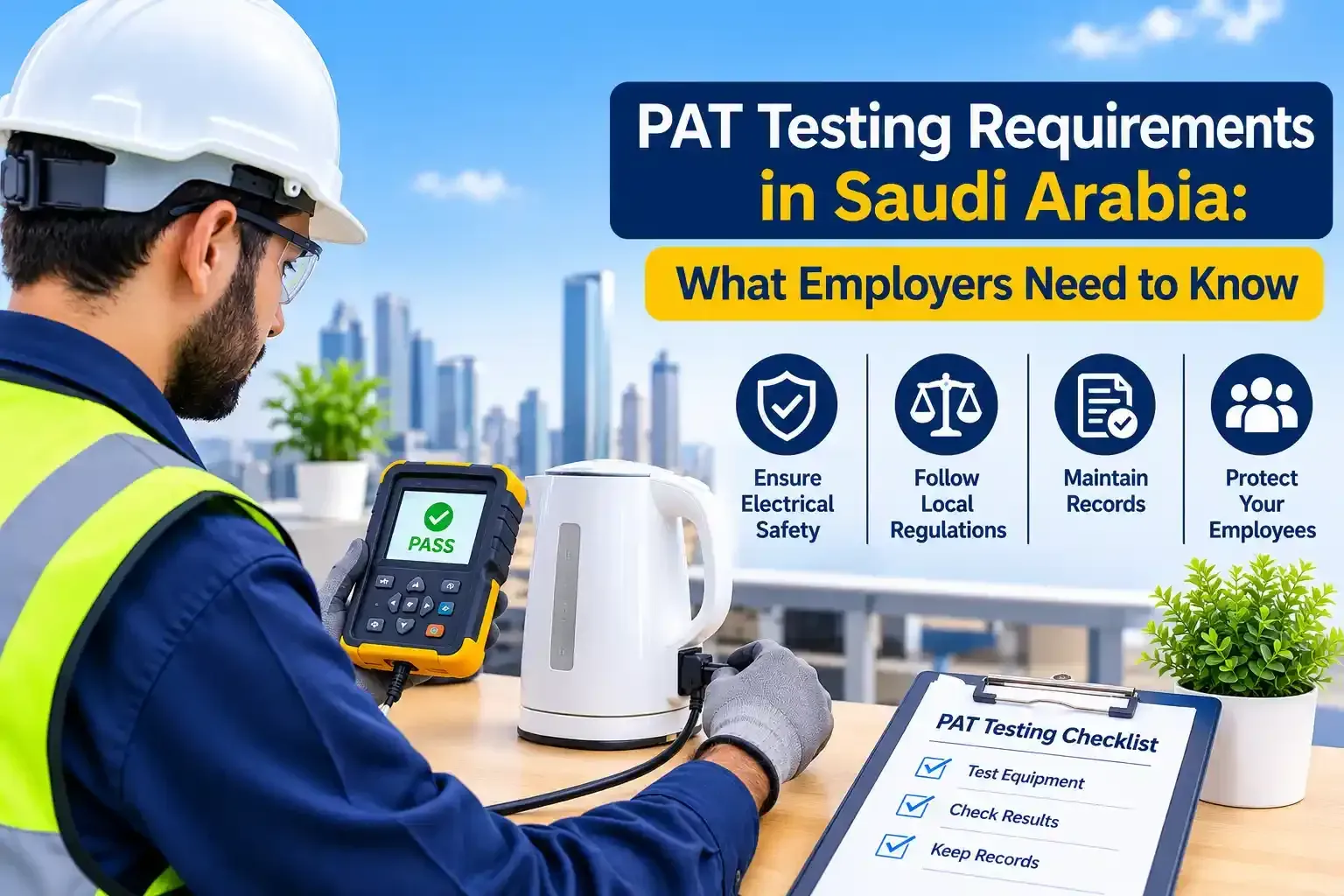
PAT testing requirements are among the most misunderstood parts of workplace electrical safety in Saudi Arabia. Many employers assume one law spells out exactly what to test and when. In practice, the rules come from several sources, and the employer carries the burden of proving that portable electrical equipment is safe to use.
Portable appliance testing is the routine inspection and testing of plug-in equipment such as extension leads, power tools, heaters, chargers and IT devices. For facility managers and HSE leads in the Eastern Province, where heat, dust and humidity punish cables and plugs, it is a practical defence against shock and fire. At General Tech Saudi, our Dammam team has supported industrial clients since 1998.
This guide explains the PAT testing requirements employers should plan for, including what PAT testing Saudi Arabia sites typically need, how often to test and how to document results.
What Are the PAT Testing Requirements in Saudi Arabia?
“PAT” is a term that originated in the United Kingdom. To our knowledge, no single Saudi regulation is dedicated only to PAT. Instead, PAT testing requirements are shaped by several overlapping sources:
- Saudi Labor Law: employers must protect workers from workplace hazards, and faulty electrical equipment is an obvious one.
- Electrical provisions in the Saudi Building Code: these govern installations and set expectations for safe electrical practice.
- Client and site standards: major oil and gas operators, industrial cities and healthcare groups often impose their own inspection rules on contractors.
- Insurance and audit conditions: insurers and auditors expect documented evidence of equipment checks.
- International practice: IEC standards and the IET Code of Practice for in-service inspection and testing are widely used as technical references.
The safest reading of PAT testing requirements is simple. If your people use portable electrical equipment, you should inspect it, test it on a risk-based schedule and keep records. Always confirm any site-specific or client-specific rule before you finalise your programme.
Electrical Safety Compliance Saudi Arabia: Why Records Matter
Electrical safety compliance Saudi Arabia auditors look for is rarely about the test itself. It is about evidence. A device that passed last month but has no record is, on paper, an untested device. That is why documentation is as important as the test.
PAT Testing for Employers: Who Is Responsible?
Meeting PAT testing requirements is a duty that cannot be handed away entirely, and PAT testing for employers always starts with clear ownership. You can hire a contractor, but accountability for safe equipment stays with the duty holder. In most workplaces, responsibility is shared like this:
- Employers and site owners: set the policy, fund the programme and act on failures.
- Facility and maintenance managers: keep the asset register and schedule tests.
- HSE leads: review results, investigate repeat failures and report to management.
- Contractors and tenants: ensure the tools they bring on site are tested too.
Whoever performs the work must be competent. They should use a suitable tester, follow a recognised method and understand the equipment classes they are checking.
What Does Portable Appliance Testing Include?
Portable appliance testing combines a visual check with electrical measurements. It is a form of electrical equipment safety testing aimed at catching faults before they injure someone.
Typical Test Steps
- Visual inspection: damaged cables, cracked plugs, scorch marks, loose fuses and missing covers.
- Earth continuity test: confirms the protective earth path in Class I equipment.
- Insulation resistance test: checks that live parts are properly separated from the casing.
- Leakage and polarity checks: identify wiring faults and unsafe current paths.
- Functional check: confirms the item works as intended.
What Should Be Included
Extension leads, power tools, portable heaters, fans, vacuum cleaners, kettles, battery chargers, desktop IT equipment and workshop lighting are the usual candidates. Hired and contractor-owned tools should be included too.
Healthcare sites should note that patient-connected medical equipment needs specialist biomedical testing, which goes beyond a standard PAT routine.
PAT Testing Frequency: How Often Is PAT Testing Required?
If you are asking how often is PAT testing required, the honest answer is that PAT testing frequency should follow risk, not a fixed calendar. Most PAT testing requirements on intervals are guidance, not fixed rules. The more punishing the environment and the more handling the equipment gets, the shorter the interval.
As a practical starting point, many employers use these intervals:
- Heavy-use industrial, outdoor or construction-type equipment: every 3 to 6 months.
- Workshop hand tools and extension leads: every 6 to 12 months.
- Non-patient healthcare equipment: every 6 to 12 months.
- Offices and commercial sites: every 12 to 24 months.
Eastern Province conditions can justify the shorter end of each range. Heat hardens cable insulation, and dust works into plugs and sockets.
Test sooner whenever equipment is new to site, has been repaired, has been dropped or shows damage. Between formal tests, users should look over a device before each use and report anything unusual.
PAT Testing Checklist for Employers
Use this PAT testing checklist to meet your PAT testing requirements and audit your programme:
- Create an asset register listing every portable item, its location and its owner.
- Classify equipment by type and risk, then assign test intervals.
- Appoint a competent tester or an external provider.
- Confirm the test instrument has a valid calibration certificate.
- Inspect and test each item, then label it with the result and next due date.
- Remove failed items from service immediately and tag them.
- Repair or replace failures and retest before reuse.
- File the report and review trends every quarter.
PAT Testing Certificate and Records
A PAT testing certificate is only as credible as the detail behind it. Auditors checking PAT testing requirements want a report they can trace back to specific equipment. A good record includes:
- Asset ID, description and location
- Test date, tester name and test method
- Measured values and a clear pass or fail result
- Instrument serial number and calibration due date
- Recommended action and next test date
Because results depend on accurate instruments, accredited calibration of your electrical test equipment should be part of the same programme. A tester that has drifted out of tolerance can pass an unsafe device.
Common Mistakes Under PAT Testing Requirements
Avoid these errors when managing PAT testing requirements:
- Testing only office items and ignoring workshop leads and contractor tools
- Relying on a sticker with no matching report
- Using a one-size interval for every environment
- Returning repaired equipment to service without a retest
- Treating PAT as a replacement for fixed installation inspection
PAT Testing Service Dammam: Choosing a Provider
When you look for a PAT testing service Dammam employers can rely on, ask how they interpret your PAT testing requirements, how results are recorded, how test instruments are calibrated and whether repairs can be handled in the same visit.
General Tech Saudi lists PAT testing among its repair and support offerings, alongside power quality analysis, UPS preventive maintenance and thermal imaging. You can review the full range on our electrical testing and maintenance services page. Our team works across the Eastern Province, Riyadh, Jeddah and Yanbu, and we can confirm the right scope for your site in a single conversation. For further engineering guidance, browse our latest updates and technical articles.
Frequently Asked Questions About PAT Testing Requirements
Is PAT testing mandatory in Saudi Arabia?
To our knowledge, no single regulation is dedicated only to PAT. However, employers have a general duty to keep workplaces safe, and many clients and auditors expect documented testing. Check your site and client rules.
How often is PAT testing required?
There is no universal interval. Frequency depends on equipment type, usage and environment, and typically ranges from every 3 months for heavy-use items to 24 months for low-risk office equipment.
What does a PAT testing certificate show?
It records each tested item, the date, the measured results, the tester and the next due date. A complete report also states the calibration status of the instrument used.
Can staff carry out PAT testing themselves?
Staff can do pre-use visual checks. Formal testing should be performed by a competent person with a calibrated tester, because incorrect testing can give false confidence.
Keep Your Equipment Safe and Compliant
Clear PAT testing requirements, a risk-based schedule and solid records protect your people and your reputation. If you are not sure what your site needs, start with an asset register and a competent tester.
General Tech Saudi (BK General Tech Services Est.)
P.O. Box 9559, Al Rabie District, Dammam 31423, Saudi Arabia
Phone: +966 569 289 544 | Email: sales@generaltechsaudi.com