

Power quality problems industrial facilities face in Saudi Arabia often look like random equipment failures, yet the real cause is the electricity itself. Drives trip, motors overheat and breakers nuisance-trip, but the maintenance report rarely points to the supply. Teams replace parts and hope the fault does not return.
This guide helps plant managers and electrical engineers recognise harmonics, voltage sags and swells early. You will learn the warning signs, the measurement methods and the fixes that work under Saudi heat and heavy motor loads. General Tech Saudi has supported industrial teams from Dammam since 1998.
Why Power Quality Problems Industrial Sites Overlook Are So Expensive
Poor power quality rarely causes a dramatic outage. It wears equipment down slowly. A drive trips weekly, a motor runs hotter than its rating, a transformer hums louder than last year.
Each event looks minor. Together they create unexplained downtime, shorter equipment life and higher energy bills.
The risk is higher in the Kingdom. High ambient temperatures leave little thermal margin. Large motors start frequently, and many plants run dense banks of variable frequency drives. All of this stresses the supply and amplifies any distortion already present.
Harmonics in Industrial Power Systems: What They Are
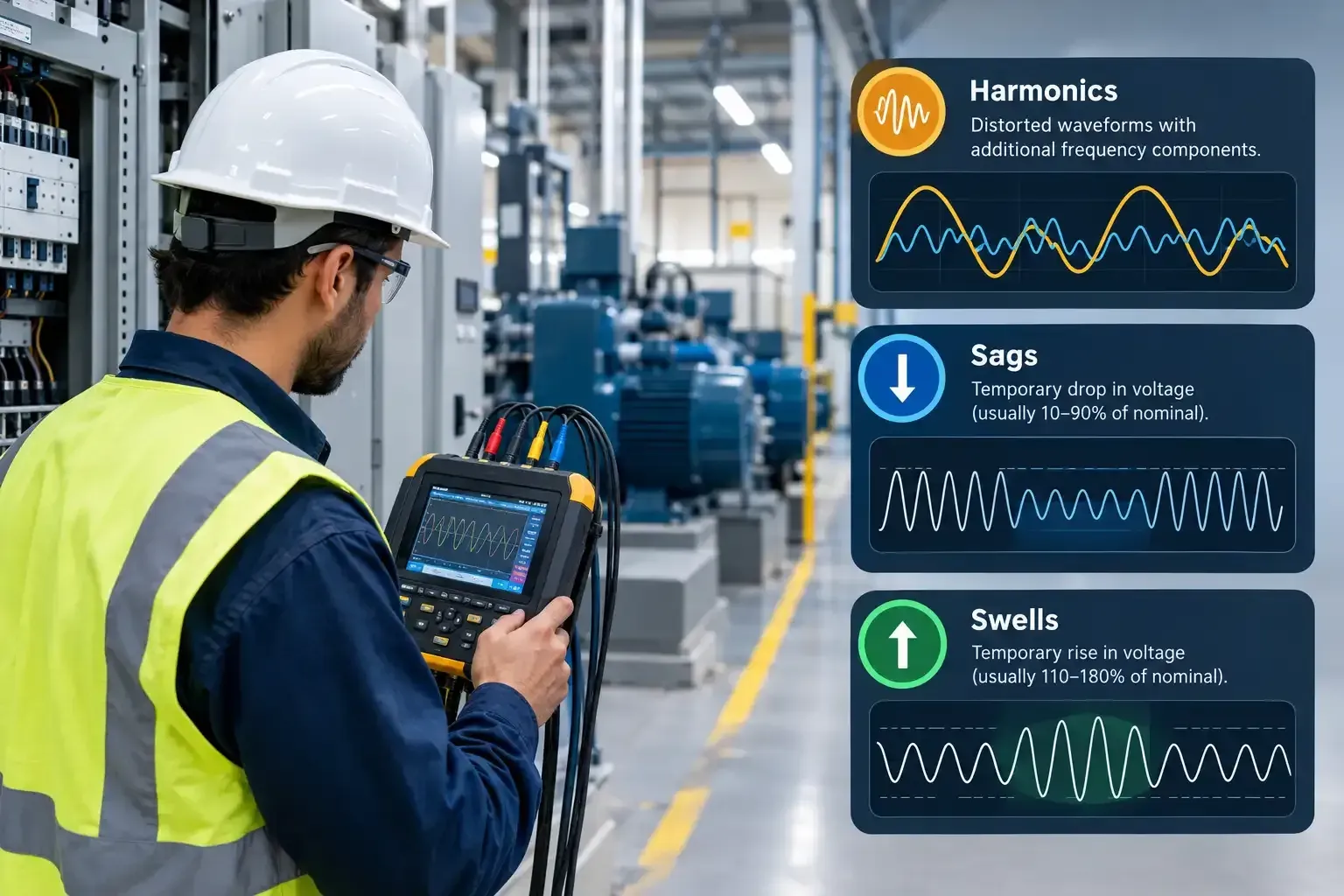
Harmonics are voltage or current waveforms at whole-number multiples of the fundamental supply frequency. They distort the clean sine wave your equipment expects.
Common Sources of Harmonics
- Variable frequency drives and soft starters
- UPS systems and rectifiers
- Switch-mode power supplies and LED lighting
- Welding machines and arc furnaces
- Battery chargers and DC drives
How to Detect Harmonic Distortion
Knowing how to detect harmonic distortion starts with symptoms, then confirms them with measurement. Watch for these signs:
- Transformers or neutral conductors running hot at normal load
- Capacitor banks failing or fuses blowing repeatedly
- Breakers tripping with no overload
- Flickering lights or erratic control behaviour
- Motors humming, vibrating or losing efficiency
To confirm, use a power quality analyser at the point of common coupling and at major loads. Record total harmonic distortion (THD) for both voltage and current, then review the individual harmonic orders. A thermal imaging survey of panels and neutrals adds a fast visual check of where distortion turns into heat.
Voltage Sags and Swells Causes and Warning Signs
A voltage sag is a short drop in voltage, typically lasting from half a cycle to one minute. A swell is a short rise above normal. Both are brief, which is why they are hard to catch without recording equipment.
Voltage Sags and Swells Causes
- Faults on the utility network or inside your plant
- Starting large motors or compressors
- Switching capacitor banks or heavy loads on and off
- Loose connections and weak feeders
- Sudden load rejection, which often causes swells
Warning Signs
- PLCs resetting or drives faulting without a clear reason
- Contactors dropping out during production
- Lights dimming when a large machine starts
- Unexplained product defects or batch losses
If these events cluster around the same time of day or the same machine, you have a pattern worth recording.
Effects of Poor Power Quality on Motors and VFDs
Left unchecked, power quality problems industrial plants tolerate become repeated motor and drive failures. The damage builds quietly:
- Extra heat: Harmonic currents add losses in motor windings and shorten insulation life.
- Torque pulsation: Distorted supply causes vibration, noise and bearing wear.
- Drive trips: Sags push the DC bus below its limit, so VFDs fault mid-process.
- Overvoltage stress: Swells stress capacitors and power electronics.
- Higher energy cost: Losses and poor power factor raise your bill.
Many plants send failed drives for repair without finding the cause. Our team handles VFD repair, starter panel customisation and power quality analysis, so the repair and the root-cause check happen together.
Power Quality Monitoring for Factories
Continuous monitoring catches intermittent power quality problems industrial plants rarely see during a one-day visit. Permanent meters on main incomers and critical feeders log sags, swells, harmonics and transients with timestamps.
Those timestamps matter. When a line stops at 2:14 pm, you can check whether a sag occurred at 2:14 pm. That turns guesswork into evidence.
Monitoring is only as good as the meter. A drifting analyser gives misleading readings, so verify your instruments on schedule. Our SAAC-accredited electrical calibration services keep analysers and test equipment traceable and audit-ready.
Power Quality Analysis Saudi Arabia Plants Should Request
A proper study goes beyond a single reading. Good power quality analysis Saudi Arabia facilities can rely on typically includes:
- A load survey across normal and peak production
- Logging for at least one full operating cycle, often a week
- Harmonic spectrum and THD at the point of common coupling
- Sag, swell and transient event capture
- Power factor, imbalance and neutral current checks
- A written report with ranked findings and recommended actions
Ask for raw data, not just a summary. Your engineers should be able to verify every conclusion.
Power Quality Audit for Industrial Facilities
A structured audit turns power quality problems industrial teams only suspect into documented findings. A power quality audit for industrial facilities combines site inspection, measurement and review of your equipment.
A thorough audit covers:
- Single-line diagram and load review
- Earthing and bonding inspection
- Thermal imaging of panels, busbars and connections
- Measurement at the incomer and critical loads
- Comparison against IEEE 519 and equipment tolerances
- Prioritised actions with cost and risk ranking
Run an audit after adding drives, expanding a line or installing new transformers. Those changes alter your harmonic profile.
IEEE 519 Harmonic Limits Compliance
IEEE 519 is the benchmark for harmonic control in industrial power systems. It sets limits for voltage distortion and current distortion at the point of common coupling, based on your system’s short-circuit strength and load.
IEEE 519 harmonic limits compliance protects you in two ways. It limits damage to your own equipment, and it prevents your plant from polluting the supply of neighbouring users. Meeting IEEE 519 limits also helps contain power quality problems industrial sites share with others on the same feeder.
To check compliance, measure at the point of common coupling over a representative period, then compare results with the limits for your system.
Fixing Power Quality Problems Industrial Plants Can Solve: Filters and Sag Protection
Once measurement identifies the cause, choose the fix that matches it. Avoid buying equipment before the data is in.
Harmonic Filters for Industrial Plants
- Passive filters are tuned to specific harmonic orders and suit stable, predictable loads.
- Active filters adapt to changing loads and cancel multiple harmonics at once.
- Line reactors and DC chokes reduce drive distortion at low cost.
- 12-pulse or active-front-end drives cut harmonics at the source.
Correct sizing depends on measured data. A wrongly tuned filter can resonate with capacitor banks and make things worse.
Voltage Sag Mitigation Solutions
- UPS systems for control circuits, PLCs and sensitive loads
- Dynamic voltage restorers for critical processes
- Ride-through settings on drives and contactor hold-up devices
- Soft starters that reduce motor starting dips
- Stronger feeders and better segregation of heavy loads
Match the solution to the cost of a stoppage. Protecting a PLC rack costs far less than protecting a whole plant.
Frequently Asked Questions
What are the most common power quality problems industrial plants experience?
The most common issues are harmonic distortion, voltage sags, swells, imbalance, low power factor and transients. Drives, rectifiers and large motor starts are the usual triggers.
How do I know if harmonics are damaging my equipment?
Look for hot transformers or neutrals, repeated capacitor failures and unexplained trips. Confirm with a power quality analyser that records THD and the harmonic spectrum.
What causes voltage sags in factories?
Faults, large motor starts, weak feeders and utility switching are the main causes. Recording event timing helps separate internal causes from utility events.
How often should a plant run a power quality audit?
Run one every two to three years, and after major changes such as new drives, transformers or production lines.
Can poor power quality raise energy costs?
Yes. Harmonics and low power factor increase losses in cables, transformers and motors, which raises consumption and can trigger utility penalties.
Get Your Plant Measured, Not Guessed
Do not let power quality problems industrial operations accept as normal keep draining uptime. Measure first, then fix what the data shows. General Tech Saudi provides power quality analysis, thermal imaging, VFD repair and accredited calibration. We also supply authorised electrical test instruments, motors and drives from leading global brands.