

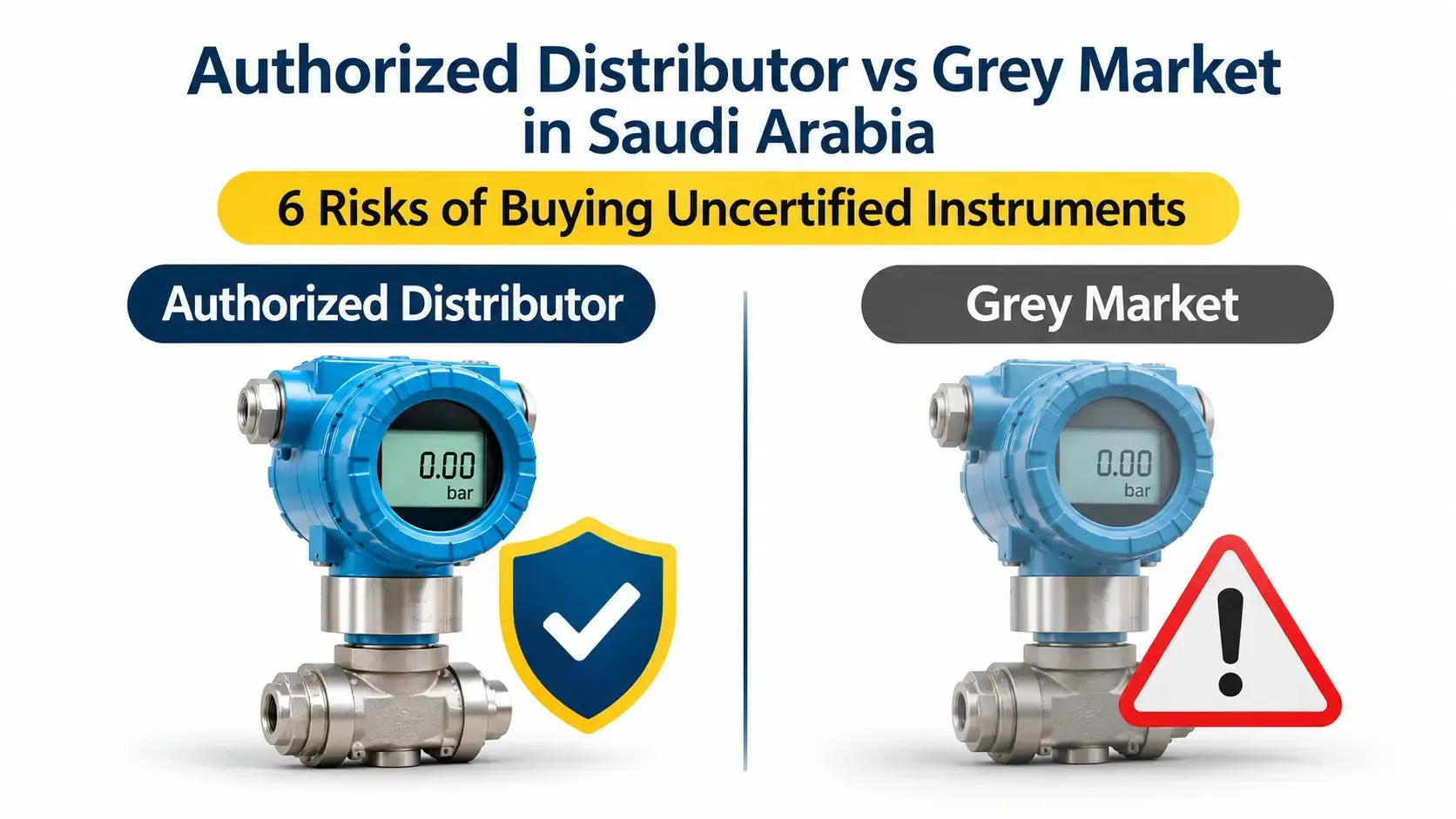
A quote that is 15% cheaper looks like a win until the instrument arrives without a warranty, a traceable certificate or any proof of where it came from. The choice between an authorized distributor vs grey market supplier in Saudi Arabia is not just a pricing decision. It decides whether your equipment passes an audit, performs safely on site and gets supported when something goes wrong.
This guide explains what the grey market is, how it differs from authorized supply, and the six risks of buying uncertified instruments. It also shows how to verify a supplier before you place an order.
What Is a Grey Market Instrument?
A grey market instrument is a genuine product sold outside the manufacturer's official distribution network. It is not necessarily fake. It may have been imported in parallel from another region, bought from surplus stock or resold by a trader who has no agreement with the brand.
Grey market is also different from counterfeit. A counterfeit is a fake made to look genuine. A grey market unit may be real, but the manufacturer has not approved the channel it came through.
When buyers say "uncertified instruments," they usually mean one or more of these gaps:
- No proof that the seller is authorized by the manufacturer for Saudi Arabia
- No traceable calibration certificate issued by an accredited lab
- No OEM documentation, conformity papers or valid warranty registration
Any one of these gaps can turn a cheap purchase into an expensive problem.
Authorized Distributor vs Grey Market in Saudi Arabia: Key Differences
The two supply routes can sell the same model number. What differs is everything around the instrument.
- Warranty: An authorized distributor passes on the genuine OEM warranty. A grey market seller usually cannot, and the manufacturer may refuse the claim.
- Documentation: Authorized supply includes manufacturer documentation, specifications and conformity papers. Grey market units often arrive with missing or mismatched paperwork.
- Supply chain: An authorized channel is traceable from factory to your site. A grey market chain is not, so history and storage conditions are unknown.
- Support: Authorized distributors have access to factory-backed spares, training and technical help. Grey market sellers rarely do.
- Accountability: If an authorized unit fails, you have a named supplier with an agreement behind it. With a grey market trader, you often have nobody to call.
For safety-critical or audited equipment, these differences matter more than the price gap.
6 Risks of Buying Uncertified Instruments
Risk 1: The Warranty Is Void or Unenforceable
The risk: Many manufacturers honor warranty claims only for units sold through their authorized channels. They can check the serial number and refuse the claim if it did not come through an approved distributor.
The consequence: If a unit fails in month three, the repair or replacement cost falls on you. This is how uncertified instruments warranty void situations usually begin, with a low price on day one and a full repair bill later.
The fix: Ask for the warranty terms in writing and confirm with the manufacturer that the serial number is valid for the Saudi market.
Risk 2: There Is No Traceable Calibration or Audit Trail
The risk: An instrument is only useful if its readings can be defended. That needs a calibration certificate showing as-found and as-left readings, uncertainty, method and traceability to national or international standards. Many grey market units arrive with no such record, or with a certificate from an unknown source.
The consequence: Auditors and clients may reject measurements from instruments they cannot trace. Contractors working to oil and gas documentation rules feel this first. Our guide to Aramco calibration requirements for contractors and suppliers shows how much documentation buyers expect.
The fix: Insist on certificates from a lab accredited to ISO/IEC 17025. If you are unsure what that means, read what ISO 17025 accreditation is and why it matters to Saudi buyers. Then learn how to read a calibration certificate, so you can spot a weak one.
Risk 3: Counterfeit, Refurbished or Tampered Units
The risk: Once a unit leaves the authorized chain, nobody can vouch for its history. A refurbished or heavily used instrument can be sold as new. Labels can be copied, and in the worst case, internal parts can be swapped or counters reset.
The consequence: A sensor that has already drifted or been abused will give unreliable readings from the first day. You may not find out until a failed inspection or a bad batch.
The fix: Buy from a supplier who can show a direct link to the manufacturer. Check serial numbers, sealed packaging and original documents before accepting delivery.
Risk 4: Safety and Compliance Exposure
The risk: Some instruments protect people. Gas detectors, torque tools on structural work, pressure instruments and electrical test equipment all feed into safety decisions. If one is wrong, a person may be put at risk.
The consequence: An unverified gas detector that fails to alarm, or a torque tool that under-tightens a critical joint, is a safety incident rather than an equipment issue. Imported equipment may also face conformity rules in Saudi Arabia, and regulated sectors such as healthcare have their own expectations. Missing papers can delay or block use.
The fix: Treat safety-critical purchases as a compliance matter, not a price comparison. Confirm conformity documents and calibration status before the instrument goes into service.
Risk 5: Wrong Variants, No Spares and No Technical Support
The risk: Grey market stock is often meant for another region. It may carry different power ratings, firmware, approvals or accessory sets from what your site needs.
The consequence: When a part fails, an authorized channel can order a factory-backed replacement. Grey market sellers often cannot, so a minor fault can leave a good instrument unusable. Nobody can help with firmware, software or application questions either.
The fix: Confirm the exact model, regional version and accessory list in writing. Ask who supplies spares and repairs after the sale.
Risk 6: Hidden Total Cost and Longer Downtime
The risk: The invoice price covers only the purchase. It leaves out the cost of re-calibration, replacements, delays and lost production time.
The consequence: A "cheap" instrument that fails an audit or needs early replacement can cost more than the authorized one. Downtime during a shutdown or a project deadline makes it worse.
The fix: Compare total cost of ownership, which includes warranty, calibration, support and service, rather than the unit price alone. Our breakdown of calibration cost in Saudi Arabia shows how those costs add up.
A Realistic Scenario: When the Cheaper Quote Costs More
This is an illustrative example, not a specific client case.
A maintenance planner at an Eastern Province plant needs ten torque wrenches before a shutdown. One supplier quotes well below the market rate and delivers fast. The wrenches arrive without a calibration certificate and without clear warranty papers.
During a quality audit, the plant cannot show traceability for the tools, so the work is paused until all ten are calibrated and documented. Two wrenches are also found out of tolerance. The warranty claim is refused because the supplier was never authorized.
The saving on the quote is gone, and so is time the shutdown schedule could not spare.
Who Is Most Exposed to Grey Market Risk?
Some sectors have less room for error:
- Oil, gas and petrochemical: Pressure, flow, temperature and gas instruments feed directly into safety and audit records.
- Power, energy and manufacturing: Production quality depends on measurement accuracy, and downtime is costly.
- Regulated industries: Pharmaceutical, food and healthcare buyers need documented traceability as a compliance requirement.
If your site works to client or regulator audits, buying only from authorized, documented sources is the safest default.
How to Verify an Authorized Distributor
Use this checklist before you buy:
- Ask for the authorization letter. It should name the brand, the territory (Saudi Arabia) and the validity period.
- Check the manufacturer's website. Most brands list their approved distributors by country.
- Verify the serial number. Contact the manufacturer or the distributor to confirm that it matches the product and the market.
- Request OEM documentation. This includes the datasheet, manual, conformity papers and warranty terms.
- Check calibration capability. A supplier with an accredited lab on hand can certify instruments properly. Our guide on how to choose a calibration lab in Saudi Arabia covers a 10-point checklist.
- Look for local stock and service. A genuine distributor has a physical presence, stock and a team that can repair what it sells.
Authorized Distributor Benefits: What You Actually Get
Buying from an authorized distributor gives you more than a safe invoice:
- Genuine OEM warranty that the manufacturer will honor
- Factory-backed spare parts and repair routes
- Technical support that matches the instrument to your application
- One accountable partner for the instrument, its calibration and its after-sales service
- Audit-ready paperwork from the first day
General Tech Saudi is an authorized distributor for a wide range of industrial brands, including Mitutoyo, WIKA, Control Techniques, SMC, ifm, Crowcon and Norbar. You can browse the full list of authorized instrument brands we supply, or explore our range as a test and measurement equipment supplier in Saudi Arabia. For most items, we offer same-day shipment across the Kingdom.
Because we also run a SAAC-accredited ISO/IEC 17025 calibration lab in Dammam, a new instrument can be calibrated and certified before it goes into service. The engineers who sell your equipment are the same ones who calibrate and repair it.
Frequently Asked Questions
What is the difference between an authorized distributor and a grey market seller?
An authorized distributor has a formal agreement with the manufacturer to sell and support its products in a given territory. A grey market seller sells genuine products outside that agreement. Authorized supply carries a valid warranty, documentation and support. Grey market supply usually does not.
Is grey market equipment illegal in Saudi Arabia?
Not always. Grey market goods are often genuine, so the issue is usually compliance, not legality. Imported equipment may still need to meet conformity and documentation rules, and missing papers can block use. Check the current requirements with the relevant authority before you buy.
Does buying uncertified instruments void the warranty?
In many cases, yes. Manufacturers often honor warranties only for units sold through authorized channels. Always confirm the warranty terms in writing, and verify the serial number with the manufacturer, before purchase.
How can I tell if a supplier is an authorized distributor?
Ask for a written authorization letter that names the brand and territory. Cross-check it against the manufacturer's distributor list. Also confirm the supplier can provide OEM documentation, local stock and after-sales service.
Can a grey market instrument be calibrated and accepted by auditors?
An accredited lab can calibrate it and issue a traceable certificate, which proves its readings are accurate at that point in time. It does not restore the warranty, confirm that the unit is genuine or guarantee spare parts and support. Buying authorized and calibrating through an accredited lab covers all three.
Buy Genuine, Calibrated Instruments From an Authorized Distributor
The price on a grey market quote is rarely the real price. Warranty gaps, missing traceability, safety exposure and downtime add up quickly. Authorized supply costs more upfront in some cases, but it protects your audits, your people and your budget.
To source genuine instruments with OEM warranty and accredited calibration from one team in Dammam, request a quote from General Tech Saudi. Call +966 569 289 544 or email sales@generaltechsaudi.com.